Friday, December 10, 2010

Projectile Motion!

To calculate a projectile motion problem, initial velocity, final velocity, accerleration, time, and distance are included, but the mass of the object is excluded. The key to solve the projectile motion problems is to break in two components, the horizontal and vertical component.
As we know that the gravitational acceleration is 9.8m/s². The acceleration in the y-component is always 9.8. If the speed of the obeject would be constant in the x-component. As we know that the speed acting on the object is just begin, the initial velocity/ the highest point of the object in y-component would be 0.
There are 4 types of projectile motion, the first type would be an object from the top and a force acting on the horizontal component. This kind of projectile motion can be solved by determining the time. In this case, the initial velocity of y-component is always zero and the velocity in x-component is always constant.
※The first type of projectile motion

The second type of the proejectile motion would be an object that has a velocity against the gravity. In the highest point of the whole projectile system, the velocity would become zero and the acceleration is determined as negative 9.8.
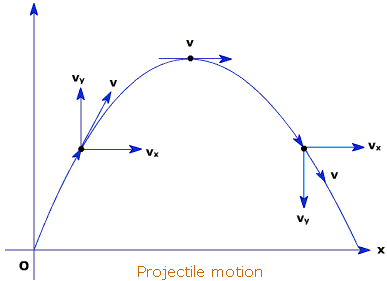
The third type of projectile motion also would be an object that have a velocity that against the gravity. But in this case, the displacement in y-component is not zero any more, there would an positive number in the y-component.

The last type of projectile motion is an object that habe a velocity that against the gravity and end with a negative displacement in the y-component.


PHYSICS BEHIND ROLLAR COASTER

  I go to wonderland often because of the rollar coaster. I am a really big fan of rollar coaster, but I haven't known about the physics behind rolllar coaster before the physics class.

  The physics in the rollar coaster is due to the gravitational force and the apply force acting on it. The friction in the rollar coaster is also an very important part of a rollar coaster. Without friction, the rollar coaster might not able to stop and the people wouldn't be able to step forward. Anthor physics behind rollar coaster is the energy of the collar coaster. As we know, Many energy in acting on an obect, the most affective energy that act on the collar coaster would be potential energy and the kinetic energy. As the rollar coaster is pulled on the top, a porential energy is created and once the rollar rolls from the top, the potential energy would transferred to both kinetic and potential energy.

Tuesday, October 26, 2010

How to add vertors

To determine the resultant : As we add straight vectors (※subtracting vectors means adding a vector in the opposite direction) , we would find the closest distance between the origin and destination. That would be our resultant. According to the Pythagorean Theorem, a² + b² = c², which "c" represents the hypoteneuse.

To determine the angle : The easiest way to measure the angle accordance to N or S is to use the protactor. But in this course, we would recommand to use the Trigonometry Theorem, Cos, Sin and Tan.


 To determine the vectors components: First, we set the positive axes, then break all vectors down into two components ( x and y). We calculate the total of x and y and follow the step as above (To determine the resultant, To determine the angle )

Thursday, October 21, 2010

How equation#4 derived from the V/T graph


In Equation #4, only V2 is usable. In another way to calculate the area of the trapezoid, we could calculate the area of the trangle and subtract the area of the triangle.   That would come out the equation #4, which is d=V2Δt-½aΔt².

Equation #4  ────  d=V2Δt - ½aΔt²
                                   ↓            ↓
                              Rectangle    Triangle


To determine the area of the rectangle, we would multiple V2 (as symbol "b" shown in the graph《Height》)  to t2 - t1, which known as Δt. (as symbol "h" shown in the graph《Height》)

It will give us an equation,
Area of Rectangle = V2Δt

To determine the area of the rectangle, we would multiple (V2 - V1) 《Base》to  Δt 《Height》divided by 2.

According to Equation #1  = V2 - V1, so, as we sub this equation,
                                         V1= V2 -  aΔt

Area of triangle = ½(V2 - V1)(Δt)
Area of triangle = ½(V2 - V2 - aΔt)Δt
Area of triangle = ½(- aΔt)Δt
Area of triangle = -½aΔt²

Displacement = Area of rectangle - Area of triangle (As we sub the equations in,)

Displacement = V2t + ( -½aΔt²)

Displacement = V2t - ½aΔt²


Tuesday, October 19, 2010

How equation #3 translates into the v/t graph


Equation #3  ────   d = V1Δt + 1/2 aΔt²
                                          ↓             ↓
                                   rectangle   triangle

As the graph above, we know that we have to calculate the area of the trapezoid to find out the displacement. But, in Equation #3, only V1 is usable. We would break down the trapezoid into a triangle and rectangle.

To determine the area of the rectangle, we would multiple V1 (as symbol "a" shown in the graph《Width》) to t2 - t1, which known as Δt. (as symbol "h" shown in the graph《Height》)

It will give us a equation of  Area of rectangle = V1Δt

To determine the area of the triangle, we would multiple (V2 - V1) 《Base》to  Δt 《Height》divided by 2

According to Equation #1 aΔt = V2 - V1, so, as we sub this equation,
Area of triangle = ½(V2 - V1)(Δt)
Area of triangle = ½aΔt(Δt)
                        
Displacement = Total Area

Displacement = Area of rectangle + Area of triangle  (As we sub the equations in,)

Displacement = ½V1Δt + aΔt²
                                      

Thursday, October 14, 2010

Translation of Graph

Graph B)
There are five sections in this graph:

Velocity →↓
Section 1) Time (in second) 0 ~ 1  : The Velocity starts at the x-axis, a horizontal line which lies on the x-axis is created.
Section 2) Time (in second) 1 ~ 3  : A horizontal line is created in the positive area at  0.75 as the walking speed is 0.75m/s [E]     Slope: 1.5(m)/2(s)
Section 3) Time (in second) 3 ~ 6  : No change in distance, so there's a horizontal line on the x-axis.
Section 4) Time (in seond) 6 ~ 7.5  : A horizontal line is created in the negative area at -0.53 as the walking speed is 0.53m/s [W]c or -0.53m/s [E]    Slope: -0.8(m)/1.5(s)

Section 5) Time (in second) 7.5 ~ 10  : No change in distance, so there's a horizontal line on the x-axis.

Acceleration →↓
 There's no acceleration in this graph. The line lies on the x-axis.

Graph C)
There are 5 sections in this graph
Velocity →↓

Section 1) Time (in second) 0 ~ 3  : A horizontal line is created in the negative area at -0.5 as the walking speed is 0.5m/s [W] or -0.5m/s[E]   Slope: -1.5(m)/3(s)
Section 2) Time (in second) 3 ~ 4  : No change in distance, so there's a horizontal line on the x-axis.
Section 3) Time (in second) 4 ~ 5  : A horizontal line is created in the negative area at 1 as the walking speed is 1m/s [W] or -1m/s [E]    Slope: -1(m)/1(s)
Section 4) Time (in second) 5 ~ 7  : No change in distance, so there's a horizontal line on the x-axis.
Section 5) Time (in second) 7 ~ 10  : A horizontal line is created in the positive area at 0.83 as the walking speed is 0.83m/s    Slope: 2.5(m)/3(s)

Acceleration →↓

There's no accelerationin this graph. The line lies on the x-axis.


Graph D)
There are 4 sections is this graph:

Distance →↓

Section 1) Time (in second) 0 ~ 2  : The distance start from 0m, and stay for 2 seconds therefore a horizontal line lies on the x-axis.
Section 2) Time (in second) 2 ~ 5  : The line goes up with a positive direction and stop at 1.5m away the origin.  Distance: 0.5(m/s)*3(s)
Section 3)
Time (in second) 5 ~ 7  : The velocity is 0, that causes a horizontal line is drawn at 1.5m.
Section 4) Time (in second) 7 ~10  : The line decreases with a negative direction and stop at 0
. Distance : -0.5(m/s)*3(s)
Acceleration →↓
There's no acceleration in this graph. The line lies on the x-axis.


Graph E)
There are 4 sections in this graph:

Distance →↓

Section 1)
 Time (in second) 1 ~ 4  : The speed increases in a speed of 0.125m/s Slope: 0.5(m/s)/4(s), so it will become a curve, a cureve which has a smaller slope at first and become gather and the line stop at 1m away the origin.
Section 2) Time (in second) 4 ~ 6  : The line goes up with a positive direction and stop at 2m away the origin.   Distance: 0.5(m/s)*2(s)
Section 3) Time (in second) 6 ~ 9  : The line decreases with a negative direction and stop at 0.8m away thre origin.  Distance: -0.4(m/s)*3(s)
Section 4) Time (in second) 9 ~ 10  : The velocity is 0, that causes a horizontal line is drawn at 0.8m

Acceleration →↓
Section 1) Time (in second) 1 ~ 4  : A horizontal line is created at 0.125(m/s2) Slope: 0.5(m/s)/4(s).
Section 2 ~ 4) There're no acceleration in section 2 to 4. The line from 4 to 10 second is on the x-axis.

Graph F)
There are 3 sections in this graph:

Velocity →↓

Section 1) Time (in second) 1 ~ 4  : A horizontal line is created in the positive area at 0.26m as the walking speed is 0.26m/s  Slope: 0.9(m)/3.5(s)
Section 2) Time (in second) 4 ~ 6.5  : No change in the distance, so there's a horizontal line on the x-axis.
Section 3) Time (in second) 6.5 ~ 10  : A horizontal line is created in the positive area at 0.43 as the walking speed is 0.43m/s 
Slope: 1.5(m)/3.5(s)
Acceleration →↓
There's no acceleration in this graph. The line lies on the x-axis.

Tuesday, October 12, 2010

Motion prelab

1. Stay at 1m away from the origin for 1 second.
2. Walk 1.5m in 2 seconds away from the origin. [0.75m/s]
3. Stay at 2.5m away the origin for 3 seconds.
4. Walk 0.75m in 1.5 seconds towards the origin. [0.5m/s]
5. Stay at  1.75m away teh origin for 2.5 s.


                                             Distance (m) VS. Time (s)

1. Start from 3m away the origin, walk 1.5m for 3s towards the origin. [0.5 m/s]
2. Stay at 1.5m away the origin for 1 s.
3. Run 1m in 1 second toward the origin. [1 m/s]
4. Stay at  0.5m away the origin for 2 s.
5. Run 2.5m away the origin in 3 seconds. [0.83 m/s]


                                Velocity

1. Stay for 2 seconds.
2. Walk at 0.5 m/s away the origin for 3 seconds.
3. Stay for 2 seconds.
4. Walk at 0.5 m/s toward the origin for 3 seconds.


                                                                                  Velocity

 
1. Speeds up  to 0.5 m/s away the origin in 4 seconds.
2. Walk in constant speed [0.5m/s] away the origin for 2 seconds.
3. Walk at [0.4 m/s] towards the origin  for 3 seconds.
4. Stop walking and stay for 1 second.


                    Distance (m) VS. Time (s)
1. Start from 0.9m away the origin, walk  0.9m away the away in 3.5 s [0.26 m/s]
2. Stay at 1.8m away the origin for 3 s.
3. Walk 1.5m away the origin in 3.5 s (0.43 m/s)


                                                                                        Velocity

1. Walk  at 0.35 m/s away the origin for 3 seconds.
2. Walk at 0.35 m/s toward the origin for 3.5 seconds.
3. Stand  for 3.5 seconds.